
For everyone, each person carries a beautiful image of a respected teacher.

Pham Van Sim checks his pupils’ work.
They may be a devoted village teacher who worries about his profession, a teacher with a visual impairment who has risen above fate to support pupils in the same circumstances as him, or a warden at a reform school, or a teacher at a charity class…All of them aim to teach and guide their pupils to become good people who live usefully for society.
Bearing the responsibility of a teacher, and also as a senior who has gone before them, the teachers with visual impairments at the Dong Nai Centre for Nurturing and Educating Children with Disabilities have been doing their utmost to help pupils in less fortunate circumstances like their own overcome their feelings of inferiority and look towards a brighter future.
Life goes on
Walking slowly out of the classroom, Luu Van Thanh (33, from Buu Hoa ward, Bien Hoa City) held our hands tightly, then pulled us to sit with him on a stone bench in the schoolyard. The teacher with a visual impairment from the Dong Nai Centre for Nurturing and Educating Children with Disabilities smiled brightly and began to tell his own story.
Thanh was born blind. In 1995, he went to Ho Chi Minh City to study at a special school for people with disabilities. In 2007, he moved back to work at the centre, where he remains. “I was born with a disability, so I understand what the children here are going through. In the past, there were times when I almost fell apart because of teasing from friends in the neighbourhood, but thanks to my family’s encouragement and urging, I decided not to give up. When I studied at Nguyen Dinh Chieu Special School (Ho Chi Minh City), a teacher advised me to become a teacher, because as a person with a visual impairment, a teacher would find the right way to guide his pupils,” Thanh said thoughtfully, explaining how he came to teaching.
Teaching life sciences and computing, Thanh regularly updates himself via the internet to find new teaching methods and exchange experience with colleagues in Ho Chi Minh City. As he spoke, Thanh opened his laptop, connected to the internet to “read” the news and chat with friends, to our surprise. “Software that helps people with visual impairments use computers has helped me a great deal, not only in teaching, but also in making friends and sharing joys and sorrows with people in the same circumstances as me,” Thanh said as he opened his electronic lesson plan and chatted with us.
Pham Van Sim (40, from Hoa An commune, Bien Hoa City) became blind and lost an arm when he accidentally stepped on a landmine at the age of 16 while working in the fields with his family in Long Thanh district. After that, Sim was very depressed, and it took him a long time to accept that he had become a person with a disability.
In 1990, Sim asked his family to let him go to Ho Chi Minh City to continue his studies. Although his family tried hard to stop him, he was determined to go. “At the time, I told everyone that I wanted to be a useful person and pursue my childhood dream of becoming a teacher. After many days, my teachers and I went to my home to persuade my family, and they agreed. Since the accident, the stories of Do Chieu and teacher Nguyen Ngoc Ky that my parents told me have always encouraged me to have the courage to realise my dream,” Sim said.
While studying in Ho Chi Minh City, Sim began to learn braille for blind people. With only one hand, he had to practise day and night to keep up with the curriculum. After 3 years of high school, then 4 years of hard work at university, Pham Van Sim earned a bachelor’s degree in education, was recruited by the Dong Nai Department of Education and Training and assigned to teach at the provincial Centre for Nurturing and Educating Children with Disabilities, where he has worked since 1998.
Lessons in being human
“I started learning braille with great difficulty. Many times I wanted to give up, but then I thought, if I did that, who would empathise with pupils with visual impairments like me? At the centre, I teach the children to get to know braille, how to write and read it. Many children cried to me because it was too hard and they did not want to go on, so I had to encourage them and find every way to help them continue. Some children, like me, became blind because of accidents or illness, so learning to read and write is even harder for them; things they used to do very quickly have now become difficult. During breaks, I take the time to seek out children in the same circumstances as me to talk and share the joys and sorrows of learning. That way, I understand my pupils better and find the best way to help them,” Sim said slowly as he showed us braille writing by first-grade pupils at the centre.
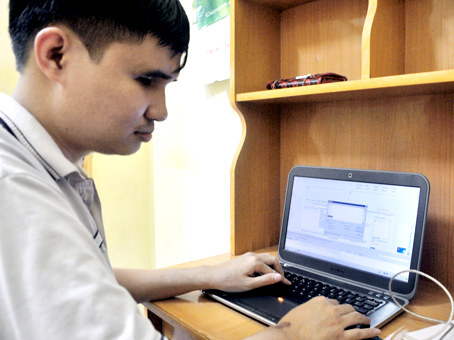 Luu Van Thanh prepares lesson plans at home.

Each class for pupils with visual impairments at the centre has about 5–10 pupils. Some are completely blind; some have cloudy eyes and can only see dimly, having to wear glasses 1cm thick and hold their notebooks close to their faces to see. Each pupil has a different background, but all want to learn to read and write and become useful people for society. Many pupils in the class for pupils with visual impairments also have other serious illnesses, such as epilepsy… So before each lesson, the teachers usually ask about those pupils’ health before starting the lesson.
Thanh said that after each lesson, he often tells his pupils a story about love for humanity that he has found online, to give them more faith in life. “Last May, Nick Vucijic came to Vietnam for an exchange, and I learned about him and told his life story to my pupils. Every pupil wants to be like Nick one day, a symbol of the resilience of people with disabilities. I always encourage them to study hard and make up for their physical impairments with knowledge and beauty of soul,” Thanh said.
Not only are they classroom teachers, Thanh and Sim are also older brothers and fathers to young children from difficult families. When a pupil is absent from school for a long time, the teachers go directly to each child’s home to ask after the family and persuade the parents to let the children go to school. The teachers have used themselves as proof for many parents that people with disabilities can still succeed if they try their hardest.
Source: http://www.xaluan.com/modules.php?name=News&file=article&sid=757890#ixzz2lGpBHrYI
read news at www.xaluan.com