We hired a blind coder and never regretted it.
Treat people with disabilities normally, and judge them on their skills and experience.
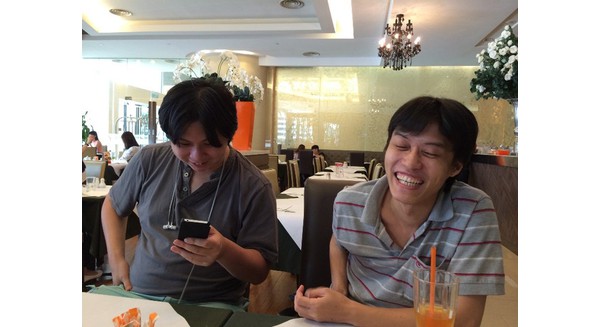
*Based on the sharing of SuYuen Chin, co-founder of MomoCentral.com, a real-time freelance platform for designers and developers.
In August 2014, we posted an advertisement looking for a developer with a link to an online coding test. We only invited candidates who passed the test to a video interview.
Our team works entirely remotely, so this was a perfect opportunity for freelancers wanting a job without having to go to an office.
A guy from Indonesia named Herwin Haliman had an excellent test result. In the video interview with me and co-founder Jason, Herwin and I talked about programming, work experience, his family and other general topics about life. Then Herwin suddenly paused and fell silent for a moment. His face clearly showed hesitation.
Jason and I did not know why Herwin had paused and thought it might be because the network was lagging. Then Herwin said: “Hey guys, there’s something I probably need to tell you”.
Us: What’s that? Go on, tell us.
Herwin: Actually, I’m blind.
Us: What do you mean?
Herwin: One of my eyes has 0% vision and the other has 10%.
Us: Wow! So you used a screen reader to complete the whole programming test?
Herwin: Yes, that’s right.
After that, Jason conducted the next stage of the interview, directly assessing Herwin’s programming and problem-solving skills. Behind the scenes, Jason and I kept talking about how amazed we were at Herwin’s ability. And this was the first time we had met a coder with a visual impairment, so we were very excited!
We agreed that we would assess him like other developers and only accept him if he passed our tests like every other developer.
Unsurprisingly, Herwin passed the interview round and completely convinced Jason. After that, we continued the process of taking him on.
To be fair, we were late in sending Herwin the necessary contract because we were stuck with other work. Herwin started to panic and sent me messages about how dedicated and hard-working he was at work despite the fact that he is a person with a disability.
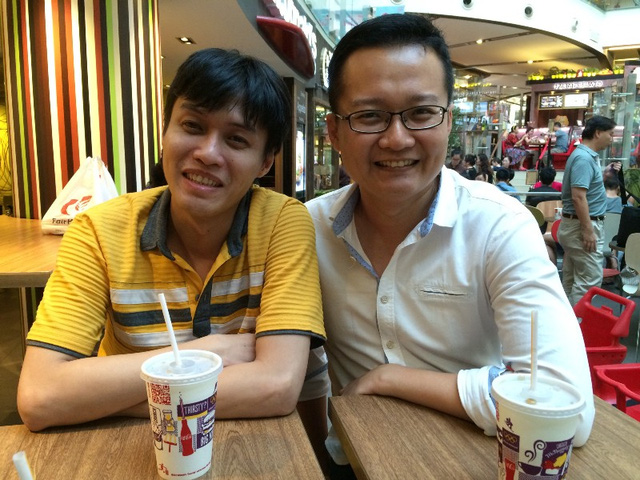
Herwin and CK on the day they met after a long time working together online
Herwin and CK on the day they met after a long time working together online
We never doubted Herwin’s efforts and never showed any doubt during the interview or while following him doing the tests. I believe Herwin’s not-so-good experiences in previous interviews and jobs made him always worried and panicky when looking for a new job. I assured Herwin there was nothing to be afraid of; we were just too busy.
When they heard this story, some people asked:
Should we pay him less than other people?
No, Jason and I agreed that we should pay him at the same rate as other people at his level. If we did not, we would hurt not only him but also ourselves.
Should we make him work overtime and work harder than other people?
No, absolutely not. There is no reason to do that when he can code fast, if not faster, than other programmers. We even allowed him to take time off to take his daughter to school and take her for health check-ups if needed…
As soon as Herwin started, he contributed a lot to our projects. He works very well, and we do not need to review his code too much. He even pays attention to every nook and cranny and issue that other programmers often overlook. He works no worse than any other non-disabled programmer.
A month later, we began building the real-time freelance platform MomoCentral for highly skilled designers and developers. At this point, Herwin became worried again because he would have to work directly with clients. Previously, our project manager negotiated and kept in touch with clients on his behalf. Herwin was afraid clients would judge him by his disability and reject him outright before talking to him.
“If a client rejects me, I will be fired, won’t I?” – Herwin asked.
His question is still vivid in my mind, just like the worry we saw in him before, while waiting for the contract after the interview. I assured him that would not happen and that we wanted him to continue working with us even if he did not win any clients.
For our part, we introduced Herwin to companies needing Android developers. We talked about our experience working with him and supported him. Some clients were hesitant, but we did not stop. For example, Soh Chong Kian (CK) – CTO of Spini, a wonderful client – gave Herwin a chance and interviewed him. After that, they worked together.
At first, we closely monitored the cooperation and communication between CK and Herwin to minimise any shortcomings that might occur. For example, Herwin might not understand text and images exactly because he depends on a screen reader. Therefore, CK had to spend some time learning how to assign a particular task to Herwin.
I also quickly learned a tip: for tasks that are purely about code, with no images, a screen reader can read them perfectly.
For tasks with more images, where most details are displayed on the screen and interactions are within the images, a screen reader cannot read them. A coder with a visual impairment would have to zoom in on the image and stare at it to see what it means. So to support coders with visual impairments, you should write out clearly what is in the image, such as describing the feature and screen interaction, in a separate place so the screen reader can read it.
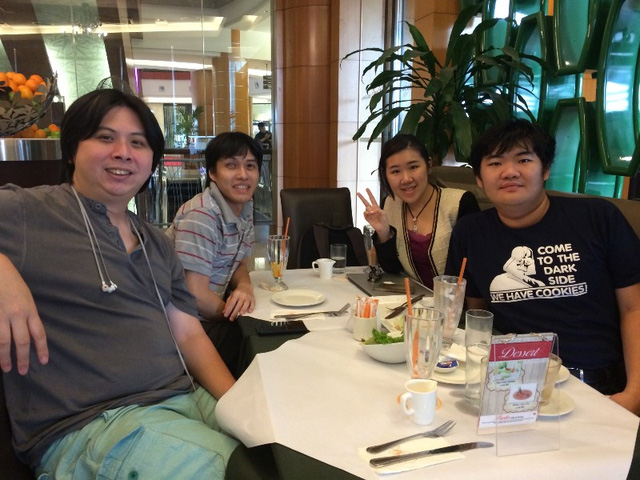
Jason, Herwin, SuYuen Chin and another developer (from left to right)
Month after month, CK continued to expand his cooperation with Herwin. Time passed quickly, and to date CK has worked with Herwin for more than a year and a half.
A few months ago, they had the chance to meet when Herwin came to Singapore for an eye check-up.
To date, the Android apps Herwin has helped build with CK’s team have hundreds of thousands of users. This is wonderful, because most startups do not reach even half the number of users that Herwin’s apps have achieved.
We hope Herwin’s story will inspire many other developers. And moreover, we want people not to judge people with visual impairments based on their disability, but instead to look at their skills and experience. You should not discriminate against them just because their vision is not good. Instead, interview them, work with them, give them tasks… just as you would treat any other employee in your company.
We especially thank Kudos and CK for giving Herwin the opportunity to work with your team at Spini!
Herwin, thank you for trusting us and believing in what we do! Let’s work together for many more years…
According to Tri Thuc Tre/GenK.com